Detection Techniques and Mitigation of Jamming Attacks in Unmanned Aerial Vehicles: A Review

Authors

  • Dr. Oluwadare Michael AYEGUN Department of Electrical and Electronics Engineering, School of Electrical Systems Engineering, The Federal University of Technology Akure, Ondo State, Nigeria Author https://orcid.org/0009-0003-6789-0116
  • Dr. Brendan Chijioke UBOCHI Department of Electrical and Electronics Engineering, School of Electrical Systems Engineering, The Federal University of Technology Akure, Ondo State, Nigeria Author https://orcid.org/0000-0002-9967-3891
  • Prof. Kayode Francis AKINGBADE Department of Information and Communication Technology, School of Electrical Systems Engineering, The Federal University of Technology Akure, Ondo State, Nigeria Author
  • Prof. Jide Julius POPOOLA Department of Electrical and Electronics Engineering, School of Electrical Systems Engineering, The Federal University of Technology Akure, Ondo State, Nigeria Author

DOI:

https://doi.org/10.65218/jius.2026.112

Keywords:

Unmanned Aerial Vehicle, Jamming Attack, Jamming Attack Detection, Jamming Attack Mitigation, Wireless Communication Networks

Abstract

The widespread adoption of Unmanned Aerial Vehicles (UAVs) has been driven by recent technological advancements, enabling their deployment in many diverse operations and missions previously considered infeasible in both military and civilian applications. UAVs communicate with ground stations through wireless systems, which are inherently vulnerable to Jamming Attacks (JAs) threats. This security threat poses a significant challenge, as it can block legitimate control signals from reaching the UAV’s receiver, potentially leading to a loss of control or even a crash. This paper presents an overview of Jamming Attack Detection (JAD) and mitigation schemes in UAV communication networks. The study reviews and analyzes approaches and results from 75 research papers published between 2008 and 2025 highlighting the state-of-the-art in JAD and mitigation strategies. Based on the identified shortcomings and emerging trends in UAV wireless communication security, the paper proposes key directions for future research.
Author Biographies

  • Dr. Oluwadare Michael AYEGUN, Department of Electrical and Electronics Engineering, School of Electrical Systems Engineering, The Federal University of Technology Akure, Ondo State, Nigeria

    Dr. Oluwadare Michael AYEGUN received his National Diploma certificate in Electrical and Electronics Engineering from the Federal Polytechnic Auchi, Edo State in 2001. He later proceeded to the Federal University of Technology Akure (FUTA), where he obtained his B.Eng., M.Eng., and PhD degrees in Electrical and Electronics Engineering in 2009, 2019, and 2025, respectively. He also obtained MTech. degree in Satellite Communication in the year 2021 at African Regional Centre for Space Science Education - English, Obafemi Awolowa University, Ile-Ife in conjunction with FUTA. He is a serving military officer in the Armed Forces of Nigeria with a specialization in Weapon Electrical Engineering. His research focuses on UAV wireless network security, systems automation, satellite communication, maritime domain awareness capability systems, artificial intelligence, weapon fire control system, ship’s navigation and communication systems. 

  • Dr. Brendan Chijioke UBOCHI, Department of Electrical and Electronics Engineering, School of Electrical Systems Engineering, The Federal University of Technology Akure, Ondo State, Nigeria

    Dr. Brendan Chijioke UBOCHI received his B.Eng. degree from the Federal University of Technology Owerri in 2008. He pursued his M.Sc.  degree at the University of Manchester Graduate School in 2011, and subsequently attained his Ph.D. degree from Swansea University, Wales, United Kingdom in 2018. Following his education, he joined the Federal University of Technology Akure, where he now works as a Senior Lecturer, researcher and doctoral supervisor. His research focuses primarily on compound semiconductor devices and power electronics technology.

  • Prof. Kayode Francis AKINGBADE, Department of Information and Communication Technology, School of Electrical Systems Engineering, The Federal University of Technology Akure, Ondo State, Nigeria

    Prof. Kayode Francis AKINGBADE received his National Diploma and Higher National Diploma certificates from Ondo State Polytechnic Owo (1992) and Polytechnic Ibadan (1996) respectively. He earned his PGD and M.Eng. degrees from the Federal University of Technology Akure (FUTA) in 1999 and 2003 respectively, and later completed his Ph.D. degree from FUTA Graduate School in 2011. Since then, he has been working at the Department of Electrical and Electronics Engineering, FUTA and currently serves as the head of department for Information and Communication Technology, FUTA. His research focuses on communication and control systems engineering. 

  • Prof. Jide Julius POPOOLA, Department of Electrical and Electronics Engineering, School of Electrical Systems Engineering, The Federal University of Technology Akure, Ondo State, Nigeria

    Prof. Jide Julius POPOOLA obtained his B.Eng. and M.Eng. degrees at the Federal University of Technology Akure (FUTA) in 1999 and 2003 respectively. He subsequently attained his Ph.D. degree from the University of Witwatersrand, Johannesburg, South Africa in 2012. Following his education, he has been working at the Department of Electrical and Electronics Engineering, FUTA and currently serves as a researcher and doctoral supervisor. His research primarily centers around signal processing, spectrum management, and cognitive radio technology.

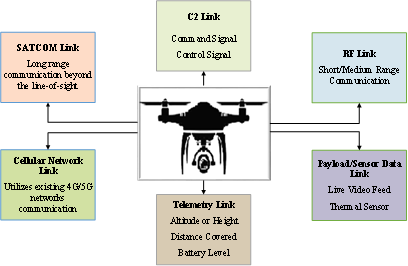
The Illustration of UAVs Wireless Communication Links

Downloads

Published

2026-07-08

Issue

Section

Review Articles

How to Cite

Ayegun, O. M., Ubochi, B. C., Akingbade, K. F., & Popoola, J. J. (2026). Detection Techniques and Mitigation of Jamming Attacks in Unmanned Aerial Vehicles: A Review. Journal of Intelligent Unmanned Systems, 1(1). https://doi.org/10.65218/jius.2026.112