Simulating and Analyzing Coordination Approaches among Unmanned Air and Unmanned Ground Vehicles for Search And Rescue Scenarios
DOI:
https://doi.org/10.65218/jius.2026.123Keywords:
Moblity, Coordination Protocol, UAV, Swamrs, Unmanned Ground Vehicles, Air-to-Ground communicationAbstract
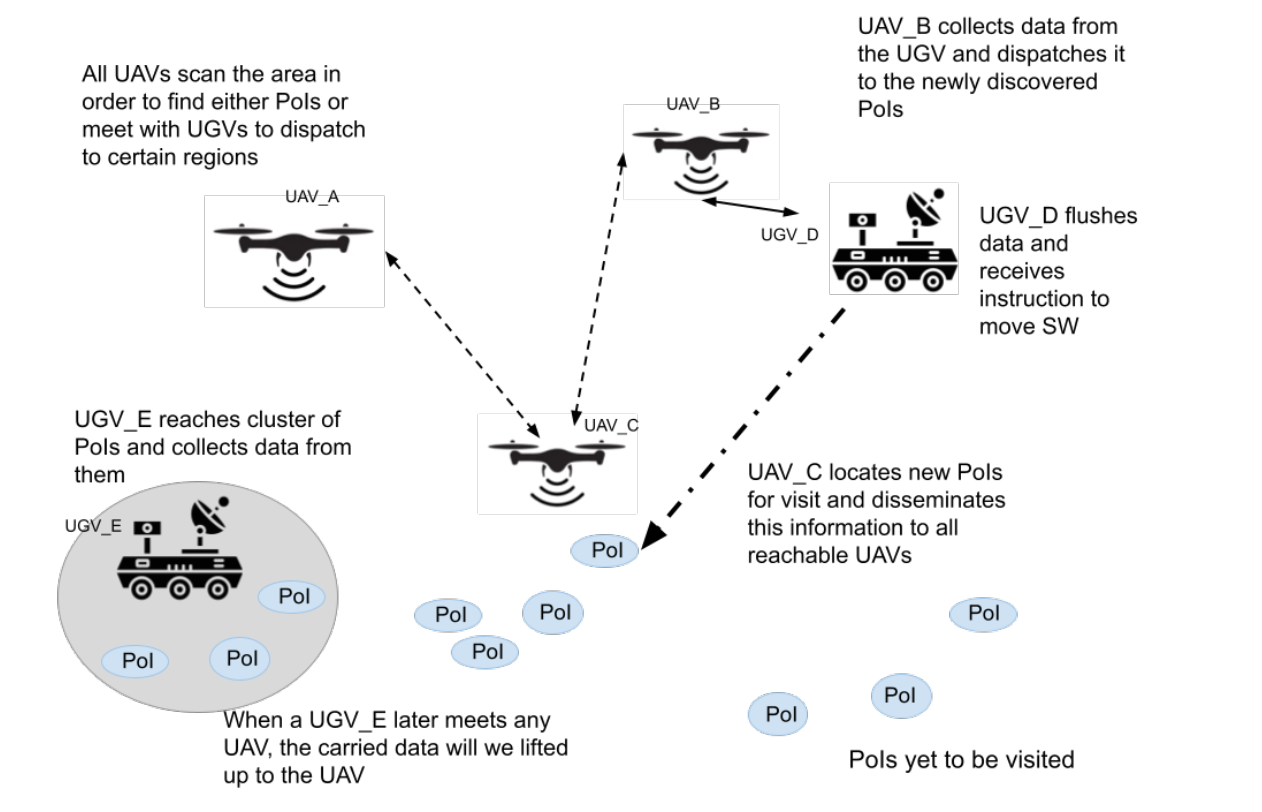
When dealing with large-scale natural disasters such as floods, landslides, hurricanes, or heavy snowfalls, there are often many victims who are trapped in hard-to-reach places, making the time to locate and rescue them critical. In this context, deploying unmanned aerial vehicles (UAVs) alongside a swarm of unmanned ground vehicles (UGVs) has the potential to speed up the Search and Rescue (SAR) missions, as the collaboration between these agents can combine advantages from both of them. The idea is that any simple UAV equipped GPS and communication capabilities can locate besieged and isolated individuals, referred to as Points of interest (POIs), and when it comes across (flies over) a GPS-limited UGV, it guides the UGVs toward the POIs. In this work, we explore different approaches to Air-to-Ground (A2G) coordination in a number of distinct scenarios among unmanned vehicles, and through simulation compare their efficiency based of parameters and metrics.
Downloads
Published
Issue
Section
License
Copyright (c) 2026 Tatiana Reimer, Bruno Olivieri, Markus Endler (Author)

This work is licensed under a Creative Commons Attribution 4.0 International License.