Multi-UAV Opportunistic Data Collection for Hybrid Ground-Air Wireless Mesh Networks
DOI:
https://doi.org/10.65218/jius.2026.124Keywords:
UAV data collection, Wireless Mesh Networks, Opportunistic data collection, Trajectory-aware data routing, Ground-air coordination, Sensor networksAbstract
We address the problem of maximizing data collection from ground Wireless Mesh Sensor Networks (WMSNs) using UAV swarms that follow fixed trajectories. Unlike most prior works that optimize UAV routes to visit sensors, we focus on scenarios where UAVs cannot change their trajectory or speed. In a real-world scenario, this constraint could be due to the computational complexity of multi-UAV path planning (NP-hard), energy saving requirements, or operational requirements such as tight time-constraints in patrol and surveillance missions. We propose the Choreographed Max Flow algorithm, which pre-computes time-staged data routing schedules for the ground network data based on the known UAV trajectory, and NODE-GAFT, its energy-aware extension. Through 132,608 simulation runs comparing eight algorithms, we demonstrate that trajectory-aware approaches substantially outperform trajectory-agnostic approaches in fixed-trajectory scenarios. We then focus on networks with specific topological patterns where the UAV swarm encounters temporally separated contact regions. On custom 3-Shape topologies, Choreographed-MaxFlow wins 69% of paired runs against the reactive MAM baseline, with gains up to $+14.0$ percentage points in Data Collection Efficiency. We also propose a temporal hiatus detector (98.4% accuracy) that enables topology-adaptive algorithm selection to dynamically configure ground mesh networks when UAVs encounter them. Our results show that our proposed approaches with pre-computed routing schedules provide a significant advantage when ground networks form topologies with temporal gaps in UAV coverage.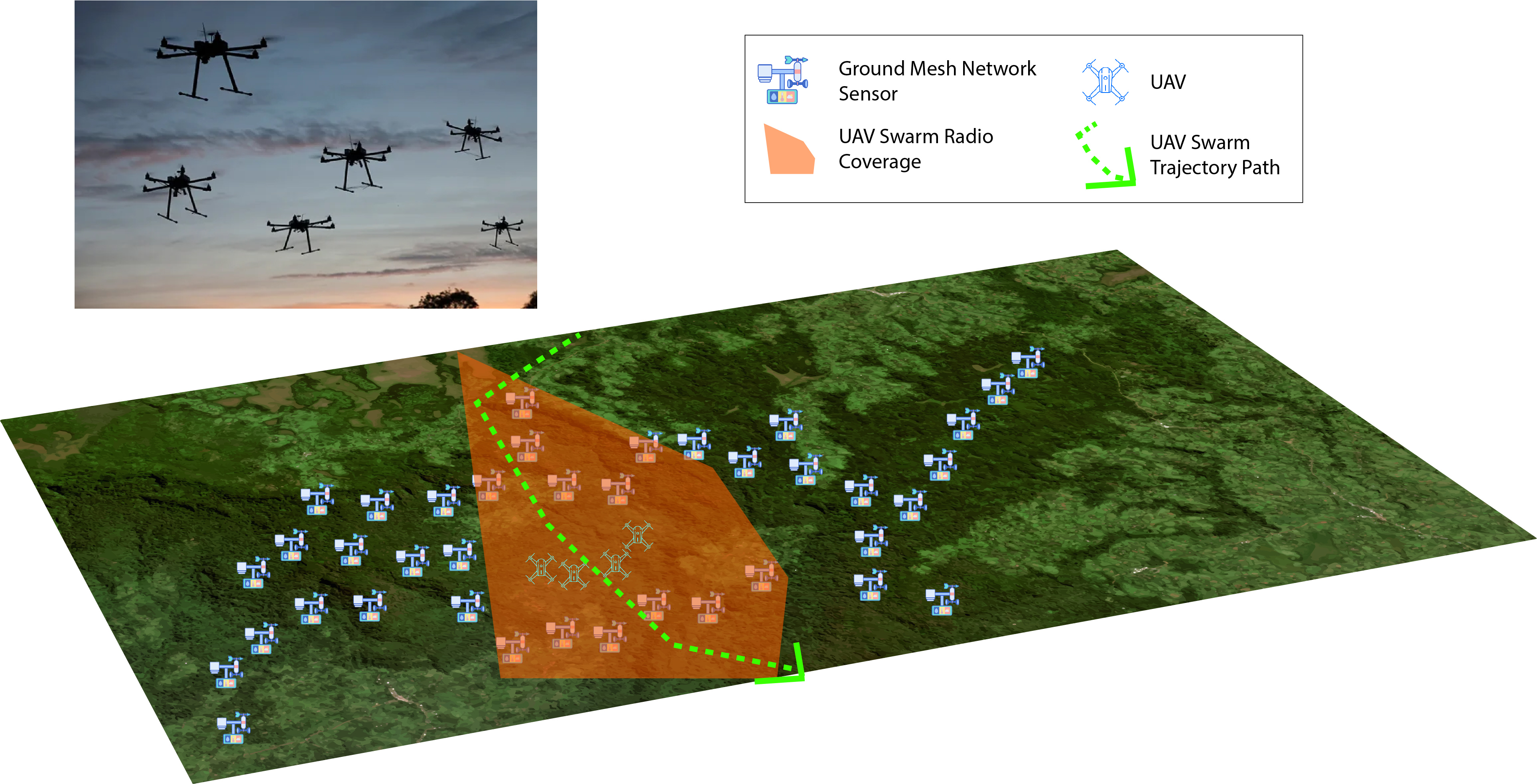
Downloads
Published
2026-07-03
Issue
Section
Research Articles
License
Copyright (c) 2026 Marcelo Paulon J. V., B. J. O. de Souza, Markus Endler (Author)

This work is licensed under a Creative Commons Attribution 4.0 International License.
How to Cite
Paulon J. V., M., José Olivieri de Souza, B., & Endler, M. (2026). Multi-UAV Opportunistic Data Collection for Hybrid Ground-Air Wireless Mesh Networks. Journal of Intelligent Unmanned Systems, 1(1). https://doi.org/10.65218/jius.2026.124