Quantum Machine Learning for Robotics: A Comprehensive Review of Algorithms, Applications, and Future Directions

Authors

  • Hassen Nigatu Robotics Institute of Zhejiang University Author
  • Gaokun Shi Author
  • Jituo Li Zhejiang University image/svg+xml , Robotics Institute Zhejiang University Author
  • Guodong Lu Zhejiang University image/svg+xml Author
  • Howard Li Author

DOI:

https://doi.org/10.65218/jius.2026.13

Keywords:

Quantum machine learning, quantum reinforcement learning, path planning, NISQ, computing, quantum optimization, multi-robot systems

Abstract

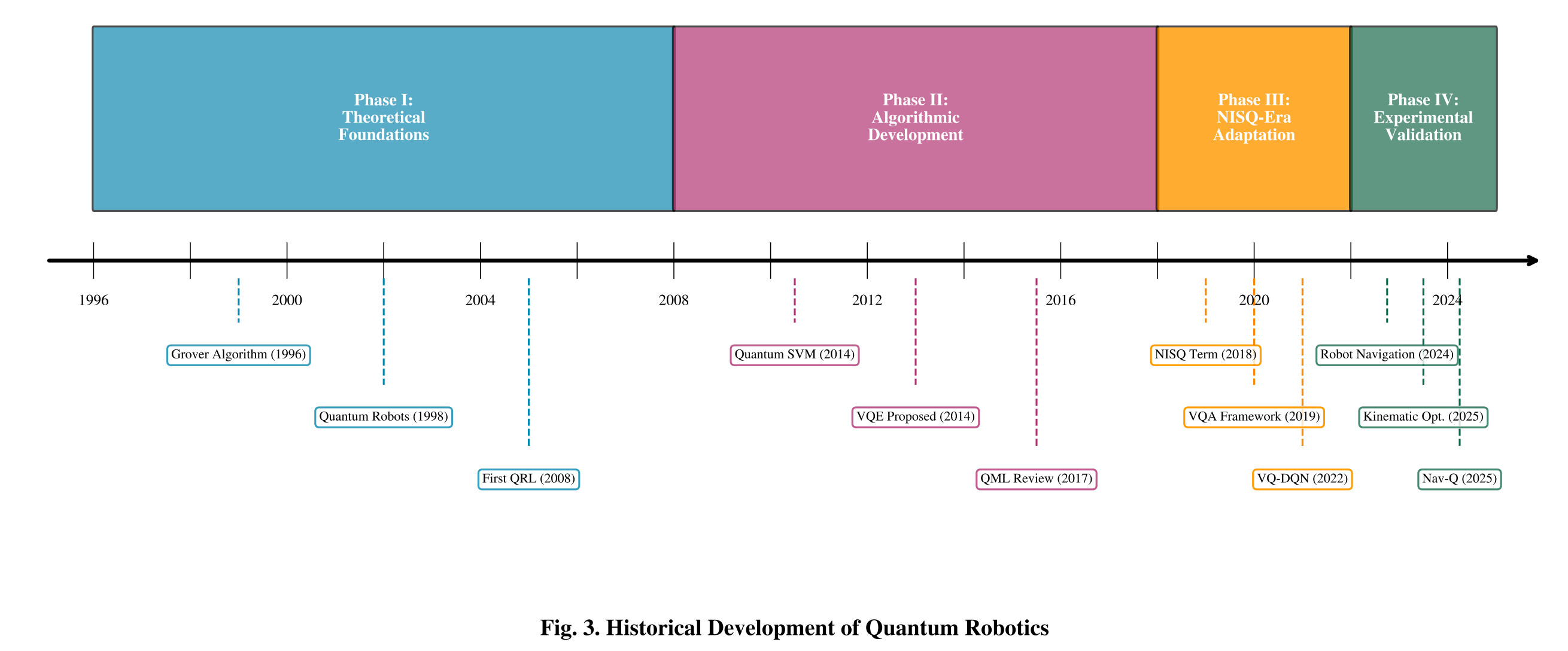
The convergence of quantum computing and robotics represents a paradigm shift in autonomous systems design, promising to overcome fundamental computational limitations that have constrained classical robotic capabilities. This comprehensive review surveys the rapidly evolving field of quantum machine learning (QML) for robotics, systematically analyzing 107 peer-reviewed contributions spanning quantum algorithms, machine learning techniques, and their robotic applications. We provide a detailed historical perspective on the field's development, from the early theoretical foundations established by Grover's search algorithm and quantum reinforcement learning proposals to current experimental implementations on noisy intermediate-scale quantum (NISQ) devices. The review systematically examines five major application domains: (1) quantum reinforcement learning for navigation and control, (2) quantum search and path planning algorithms, (3) quantum-enhanced localization and mapping, (4) quantum optimization for inverse kinematics and task allocation, and (5) multi-robot coordination and swarm intelligence. For each domain, we present detailed algorithmic formulations, computational complexity analyses, and critical assessments of experimental results. Our analysis reveals that while provable quantum advantage in robotics remains largely prospective, recent demonstrations show promising results: quantum deep reinforcement learning achieving 40\% parameter reduction in navigation tasks, Grover-based kinematic optimization demonstrating up to 93x speedups, and quantum annealing providing practical solutions for multi-robot routing. We identify key technical challenges, including barren plateaus in variational circuits, noise-induced performance degradation, and the quantum-classical integration bottleneck. Finally, we outline a strategic roadmap for quantum robotics research, distinguishing near-term opportunities in hybrid algorithms from long-term goals requiring fault-tolerant quantum computation. This paper serves as both an authoritative technical reference and a comprehensive guide for researchers working at the intersection of quantum computing and autonomous systems.
Author Biographies

  • Hassen Nigatu, Robotics Institute of Zhejiang University

    Hassen Nigatu is a distinguished senior researcher specializing in parallel robotics, screw theory, Lie groups and Lie algebras, quantum computing, and optimization algorithms, with a particular focus on their applications in robotics. His research bridges the fields of robotics and quantum computing, aiming to leverage advanced mathematical frameworks and quantum techniques to address complex challenges in robotic systems.

    Hassen earned his PhD from the Korea Institute of Science and Technology (KIST) in collaboration with the University of Science and Technology (UST). Throughout his academic career, he has made significant contributions to both the theoretical and practical aspects of robotics, including the development of novel optimization algorithms and the application of quantum computing in robotic control and planning. He is currently a distinguished senior researcher at the Robotics Institute of Zhejiang University.

  • Jituo Li, Zhejiang University, Robotics Institute Zhejiang University

    Jituo Li is currently an associate professor of the School of Mechanical EngineeringZhejiang University, China. He is also with Zhejiang University Robotics Institute. He was an assistant professor of the Institute of Automation, Chinese Academy of Sciences. He is or was the PI of several projects of NSFC(Natural Science Foundation of China), National Key R&D Program of China, BNSF(Beijing Natural Science Foundation), ZPNSF (Zhejiang Provincial Natural Science Foundation of China),etc.

    Please refer to the right item "Publications" for his research work.

  • Guodong Lu, Zhejiang University

    Prof. Lu Guodong was born in 1963. He obtained the bachelor’s degree from ZhejiangUniversity in 1983. Since graduation, he has been with Zhejiang University(ZJU). First as a teaching assistant and then was prompted to be a lecturer, an associated professor and a full professor in 1988, 1993 and 1999, respectively. He obtained his MEng in CAD in 1993 and Ph.D in applied mathematics in 2000 both from ZJU. He has been a doctoral supervisor since 2001.

    Prof. Lu holds several tiles in ZJU, among them the representative ones are the Deputy Director of the Institute of Engineering and Computer Graphics under the Department of Mechanical Engineering, the Deputy Dean of Undergraduate School, the Director of the Teaching & Researching Division, and the Deputy Dean of the honors college of Chu Kochen. He also is the secretary-general of the Guiding Committee of Engineering Drawing Education under the Ministry of Education of P.R. China, the member of the Guiding Committee of Experimental Education under the Ministry of Education of P.R. China, the director of the Guiding Committee of Experimental Education of Zhejiang Province, and the vice director-general of the Engineering Drawing Society of Zhejiang Province.

  • Howard Li

    Howard Li (PEng, PhD, IEEE Senior Member, IEEE Standards Board, IEEE Industry Activities Board) is a professor in the Department of Electrical and Computer EngineeringUniversity of New Brunswick, Fredericton, New Brunswick, Canada. He is a registered professional engineer in the Province of Ontario. He obtained his Ph.D. from the University of Waterloo, Waterloo, Ontario, Canada. He has conducted research at the University of New Brunswick, Canada, Ecole Polytechnique Federale de Lausanne, Switzerland, University of Pavia, Italy, the Department of Systems Design Engineering and the Department of Electrical and Computer EngineeringUniversity of Waterloo, Canada, and the School of Engineering, University of Guelph, Canada. Before he joined UNB, he was employed by Atlantis Systems International in the development of training systems for the F/A-18 Hornet fighter aircraft for the Boeing companyCanadian ForcesRoyal Australian Air Force, and training systems for Royal Danish Air Force. He has developed control software and hardware for unmanned ground vehicles, unmanned aerial vehicles, autonomous underwater vehicles, and mobile robots for Defence Research and Development Canada and Applied AI Systems Inc. for both domestic and military applications.

Historical Development of Quantum Robotics

Downloads

Published

2026-06-30

Issue

Section

Review Articles

How to Cite

Nigatu, H., Shi, G., Li, J., Lu, G., & Li, H. (2026). Quantum Machine Learning for Robotics: A Comprehensive Review of Algorithms, Applications, and Future Directions. Journal of Intelligent Unmanned Systems, 1(1). https://doi.org/10.65218/jius.2026.13